Introduction
THE “PLUNDERING OF CULTURAL HERITAGE in developing nations” calls to mind, quite rightly, the West’s centuries of looting physical cultural properties from countries which, due in large part to that looting, remain economically behind Western Europe and North America. The physical devastation of non-Western countries, including the theft and destruction of cultural property, has also contributed enormously to disparities in wealth and health indices between the West and the regions of the world that the West has ransacked. India, Venezuela, Iran, Vietnam, and the Congo are just a handful of examples.
However, it is important to remember that the “plundering of cultural heritage” can be more than physical. It can be both spiritual and intellectual. The “cultural heritage” that the West steals or obliterates does damage that goes far beyond the physical loss of that heritage. To lose one’s cultural property is to lose one’s sense of pride, one’s sense of ownership of a common past, one’s sense of place in a (until recently, and still to a large extent) Western-dominated world. In that sense, perhaps the loss of written records can be even more traumatic than the loss of cultural heritage from a temple, shrine, palace, or sacred burial site. Perhaps the willful erasure by Western actors of a country’s or a people’s written connection to history can be not just harmful but fatal for a collective identity, a culture living on in the present (Trouillot, 1995). The confiscation, concealment, destruction, or otherwise removal of an archival record from a nation can have consequences much worse than even the loss of a treasured cultural relic can inflict.
Also, the “plundering of cultural heritage” can take place in nations that are not commonly considered today to be “developing.”
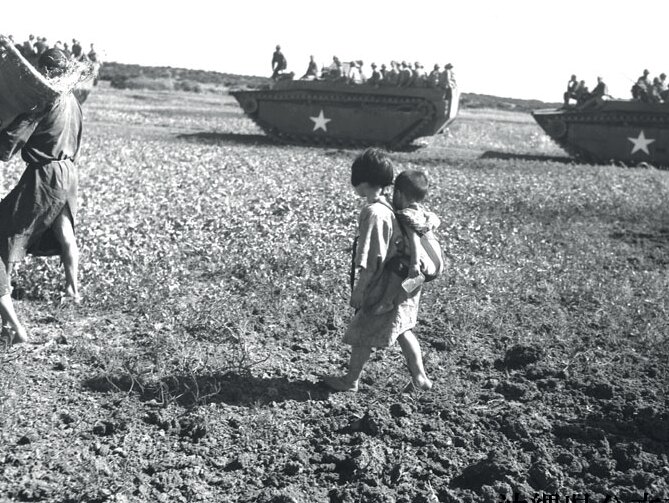
In this essay, I present a little-known but highly significant incident of sustained cultural heritage plundering by a Western country. The place of plunder was Japan, which today ranks among the five most powerful economies in the world. In 1945, however, the country of Japan lay in economic and physical ruin, the victim of an indiscriminate bombing campaign by the United States targeting mainly defenseless civilians. Following Japan’s defeat in the Greater East Asia War in August of 1945, the Americans began an occupation of the country that included an extensive and highly effective regime of censorship of the press, textbooks, and already-published works. While the Japanese Empire had engaged in censorship at home and abroad before 1945, the scope and aim of the American censorship regime were different. The goal appears to have been the psychological dismantling, or “disarmament,” of a fierce erstwhile enemy (Aoyagi, 2017). The American occupation authorities, seeking to dismantle Japan psychologically, confiscated copies of more than seven thousand book titles, a group of works known today by the name historian Nishio Kanji gave to them: funsho ( 焚書 ), or “burned books.” Nishio explicitly draws on this history in his framing of the funsho of postwar Japan. These “burned” (in reality, confiscated) books represent a nearly-lost legacy of cultural achievement in Japan. However, efforts by a few Japanese scholars and concerned citizens, including Nishio, to recover these censored books reveal not only, at least in part, the cultural and psychological devastation wrought by the Americans during the postwar and the resiliency of local populations in the face of relentless kinetic, economic, and psychological warfare, but also much of the nature of current, American-dominated geopolitical realities in Japan.
How the Books Were “Burned”
The American occupation of Japan (1945-1952) was much more than military. In imposing a new constitution on Japan in 1947, seeing through the passage of eugenics legislation (Yūsei Hogo Hō) in 1948, and, three years after the occupation officially ended, funding the creation of the Liberal Democratic Party in 1955 as a vehicle for American power in the country, Washington transformed Japan politically, biopolitically, economically, geopolitically, and even epistemologically, creating a vassal state without equal in the American Empire. The old Japan, the Japan that had dared to fight Washington, was erased, and a new Japan, a pliant supplicant to American hegemony, was transplanted in its place (Yoshida, 2016).
However, how did Washington do this? Until August of 1945, the Empire of Japan had been locked in a bitter war with the United States, as well as with the Nationalists in China, other Allies, and, later, the Soviet Union. How did the American occupiers who arrived in September succeed in turning a formidable enemy into a complacent junior partner? The answer lies in large measure in the erasure of Japanese history and identity through a systematic propaganda and information warfare program carried out by Washington and collaborators inside Japan. Some examples of American censorship and information war during the Occupation include the well-known GHQ (General Headquarters)-directed purge of communist and other leftist figures, the War Guilt Information Program (WGIP), and the press code (Sekino, 2015; Sekino, 2016; Takahashi, 2014; Takahashi, 2019; Ōmori, 1975; Ōmori, 1976). The purpose of this widescale manipulation of information was to induce a state of helplessness and disorientation, making it unlikely that Japan would ever again stand up to Washington in the latter’s imperial drive in Asia and the Pacific.
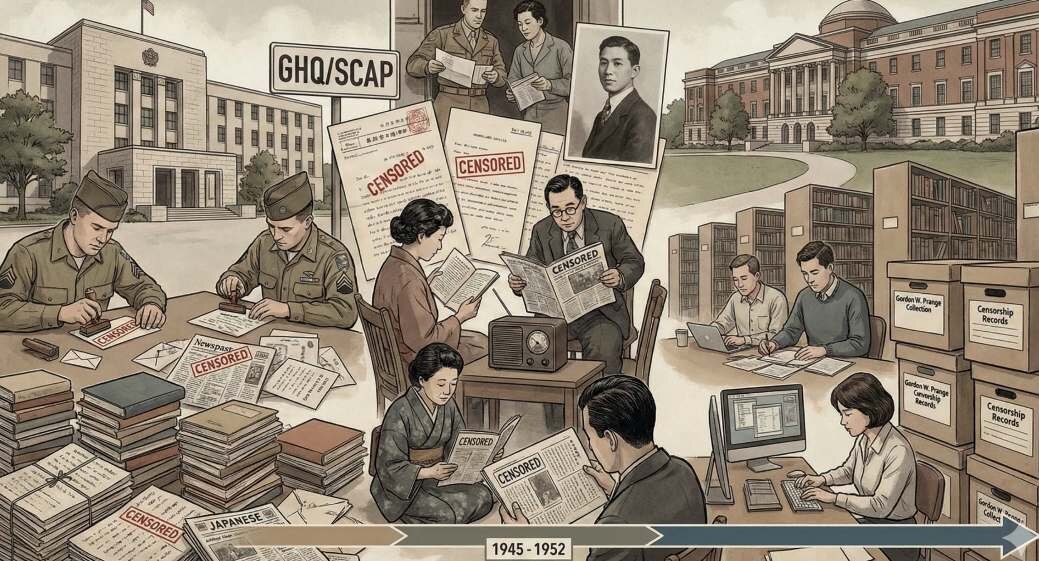
The WGIP, as described in a March 3, 1948, directive issued by the Civil Information and Education (CIE) section of the Supreme Command for the Allied Powers (SCAP), GHQ, set forth the objectives of Washington’s information warfare. The WGIP, according to the document, was to “make clear to all levels of the Japanese public the facts of their defeat, their war guilt, [and] the responsibility of the militarists for present and future Japanese suffering and privation” (General Headquarters [GHQ], 1948). The WGIP was “first initiated” from “October 1945 to June 1946,” and was broad in scope, having been “implemented through all public information media in Japan; newspapers […], books […], magazines […], radio […], and motion pictures” (GHQ, 1948). The press code, which SCAP launched with a September 19, 1945, directive (SCAPIN 33), worked along similar lines as the WGIP. The press code, really a sweeping censorship program, set forth thirty categories of forbidden discourse, including criticism of the Occupation and any mention of war crimes committed by the Allies (Morgan, 2024, pp. 14-16). GHQ stood up a Civil Censorship Detachment (CCD) on October 8, 1945, to oversee the censorship of virtually all Japanese public discourse, as the Occupation authorities had ordered (Kamijima, 2018, p. 27).
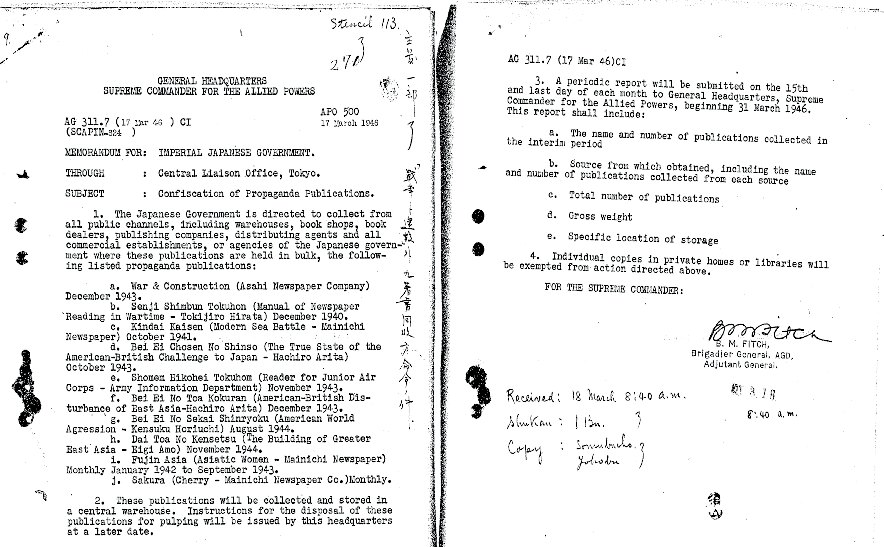
While scholarly attention inside of Japan has been directed in recent years toward the WGIP and the press code, by far the most important pillar of the Americans’ postwar cultural lobotomization of Japan was the listing and confiscation of what GHQ in Tokyo referred to as “propaganda publications.” In a March 1946 memorandum (SCAPIN 824) on the subject of “Confiscation of Propaganda Publications,” the American Occupation ordered as follows: The Japanese Government is directed to collect from all public channels, including warehouses, bookshops, book dealers, publishing companies, distributing agents, and all commercial establishments, or agencies of the Japanese government where these publications are held in bulk, the following listed propaganda publications (CIS, 1946).
The listed “propaganda publications” expanded far beyond those listed in the original 1946 memorandum. By 1949, the Japanese government, working at the behest of the Occupation, had confiscated more than 7,700 titles. A 1949 Monbushō report listing the confiscated works runs to 215 pages (Monbushō Shakai Kyōikukyoku (Ed.), 1949). The American government had held high a banner of freedom and democracy during its drive to conquer the Pacific Ocean. Once in Japan, the same government, continuing to boast of its “democratization” of its former enemy, launched and sustained one of the most thorough revisions of history and reprogrammings of an entire society in the twentieth century.
This widespread, systematic censorship campaign was thus emblematic of American activities in and against Japan during the postwar period. As Japanese scholar Etō Jun (1932-1999) has demonstrated, the American Occupation authorities, working with collaborators in the Japanese government and media, created what Etō called a “closed linguistic space” ( tozasareta gengo kūkan ) (Etō, 1994; Etō, 2015, pp. 188-212). The censorship was so extensive and seamless that many Japanese people did not even realize that their information horizons were being pulled into a line coterminous with the extent of Washington propaganda. Washington did not begin its propaganda activities after first landing on the Japanese coast. Washington’s censorship, ranging often to cultural genocide, of non-white people began long before the war with Japan was on the horizon. The history of virtually any indigenous group in North America or the Pacific, including the Philippines, is likely to include a period of attempted cultural erasure at the hands of Americans (Adams, 2020; Talbot, 2015; McGranahan, 2010, 163-183; Conboy & Morrison, 2002; Schueller, 2019). However, in Japan, this aspect of Washington’s rule was also whitewashed. Not only was there no postwar discussion in Japan of Japanese history beyond what Washington would allow, but there was also no discussion allowed of America’s history of cultural and bodily extermination campaigns in Hawai’i, against Native Americans, against Filipinos, or elsewhere. The Japanese information-consuming public not only did not know the truth about the recent war and the nature of the occupying government, but, thanks to the “closed linguistic space,” did not even know that it did not know. Censorship was complete.
Another Kind of Cultural Destruction
Indeed, the American Occupation did not initiate information control in Japan. As scholar Ruriko Kumano writes: The US Occupation’s education reforms must be evaluated against the background of Japan’s pre-war system. Officials at the GHQ in Tokyo were aware of the brutal persecution of “dangerous thoughts” in Imperial Japan, a history of thought-control that had started from the 1868 Meiji Restoration and lasted till the utter defeat in 1945. This painful history is a pertinent backdrop to the US zeal for drastic reform during the American Occupation (summer of 1945-spring of 1952) (Kumano, 2023, p. 5).
There was, as other scholars have observed, a prewar and wartime “empire of censorship” in Japan, with often more continuity than rupture between the prewar, wartime, and postwar periods (Kōno et al., 2014; Hori, 2012, pp. 142-146). In one particularly well-known case, the progressive magazine Chūō Kōron was subjected to harsh censorship by Japanese authorities who did not take kindly to the publication’s liberal, internationalist editorial line (Chūō Kōronsha (Ed.), 1965, pp. 278-302). GHQ was not the first to squelch the exchange of views in Japan, then. American Occupation censors inherited, used, and, in many ways, even enhanced a pre-existing censorship regime (Maki, 2014, pp. 389-395).
However, historian Nishio Kanji (1935-2024) distinguishes the burned books (confiscated literature) actions of GHQ from censorship, as practiced by the Japanese government. Censorship, Nishio argues, is partial and often noticeable, but book burning (book confiscation) is total, and, by that same measure, culturally debilitating. “From January 1, 1928, until September 2, 1945,” Nishio writes: Approximately 220,000 titles were published in Japan. Of that number, 9,188 books were selected out [by GHQ] for inspection, and, of those, 7,769 were designated ‘Propaganda Publications for Confiscation’ [bosshū sendenyō kankōbutsu].
This selection and confiscation are what I refer to here as the ‘burning of books’
[funsho kōi]. The Occupation authorities drew up the master list of 7,769 titles.
The Japanese government carried out a nationwide confiscation of those titles.
It is within reason, perhaps, that the Occupation forces would seek to confiscate the works that together expressed the vast body of wisdom that was of decisive importance in forming the will to fight during the period of the Greater East Asia War. From the Japanese side, however, the loss of this body of work is tantamount to the occultation of history as a whole.
Some may argue that the confiscated titles contained books that were products of whipped-up wartime fanaticism, but fanaticism is itself part of history. ‘Book burning’ is, then, a separate thing from ‘censorship’. Not only separate, but an area of study of such great importance as to be without parallel in terms of issues impinging on a country’s historical continuity. Another problem is the question of why the confiscation of these thousands of volumes has never been taken up until the publication of this series (Nishio, 2008a, pp. 17-18).
Nishio’s last point above gets to the heart of what the American Occupation’s “book burning” did to the Japanese psyche and sense of cultural identity. As if to confirm Etō’s point of a closed-off discursive space, Japanese historians prior to Nishio did not undertake any large-scale investigation of the more than seven thousand titles that the foreign army that had occupied their country had ordered stricken from the historical record. (Historian Jonathan Abel (2012), however, is skeptical of the scale of the censorship as Nishio has presented it.)
While the prewar and wartime Japanese state censored the Japanese press extensively, most readers knew that censorship was taking place. Journals that had been censored often used circles or other marks to indicate where forbidden words and sentences were, making the censorship obvious to any reader. (Figurative) Book burning, however, was a trackless suppression of information. Not only that, but in depriving an entire people of their historical and cultural legacy, the American book burning in Japan left the Japanese without the psychological ballast even to mount a recovery of their own, uncensored past. A people without a history, without a culture, is a people that must remain dependent on a conqueror. This is precisely what has happened, and what remains the case, in Japan today, which is host to more American military facilities than any other country on earth apart from the mainland United States (Ministry of Defense of Japan, n.d.).
Recovering the “Burned” Books
Many of the “propaganda publications” that the American Occupation authorities ordered confiscated were works of history and politics. Reading through recovered and republished copies of these books is a jarring exercise in decolonization. Many volumes contain information vastly different from the Washington view of world events. Following Nishio Kanji’s lead in selecting out funsho for spotlighting here, as well as the lead of other public intellectuals who have pre-selected some of the thousands of funsho titles for reintroduction to the public, I briefly introduce below some of the funsho to give an idea not only of what kinds of books Washington censors wanted made unavailable in Japan, but also what kinds of ideas, in general, Washington continues to disallow today.
Many of the works which Washington suppressed in postwar Japan contain accurate representations of racism and cruelty in the United States, as well as of the racism and cruelty of Europeans in African and Asian colonies. This is not an exoneration of Japan, to be sure, but it is a reminder that Washington censors were aware of their racism and were at pains to erase representations of it abroad. As with the censorship of reporting on acts of rape and other assaults against Japanese civilians by American servicemen, and as with the virtual excising of the atomic bombings of Hiroshima and Nagasaki from the proceedings of the International Military Tribunal for the Far East (“Tokyo Trial”), with the suppression of thousands of works of Japanese history, politics, and other subjects, the full historical record of American crimes in Asia and the Pacific was repurposed in furtherance of Washington’s preferred narrative (CIS, 1945). To Japanese readers with access only to the sanitized, propagandized version of “history,” the United States seemed a beacon of democracy, a paragon of racial harmony, and a selfless champion of human rights worldwide.
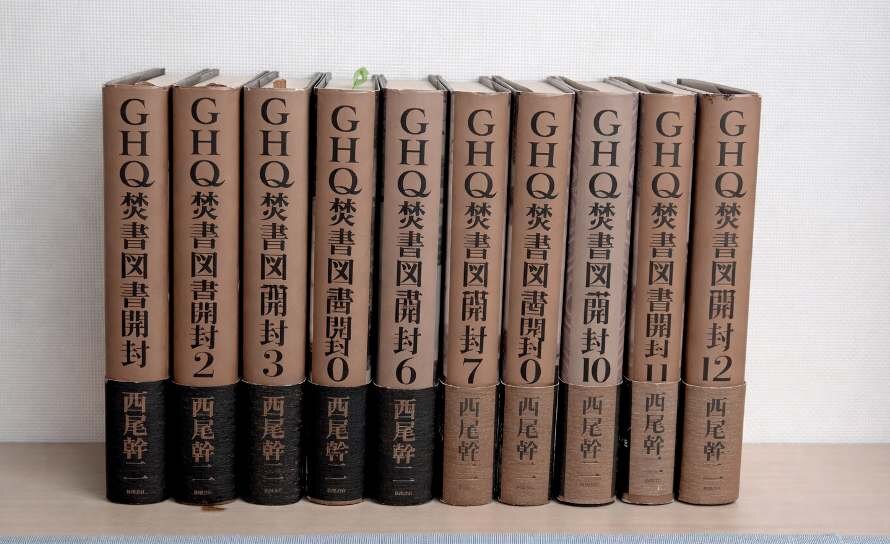
Things might have remained in this state had some conscientious researchers and public intellectuals in Japan not begun to recover the cultural and historical legacy that the Americans had tried to destroy. The above-mentioned Japanese historian, Nishio Kanji, was a pioneer in researching American censorship in Japan during the postwar period. Nishio published several volumes about the funsho , or “burned books,” that the Americans confiscated as “propaganda” beginning with the 1946 directive. The first of this series, published in June of 2008, opens with photographs of some of the original volumes—a reminder that what the Americans thought they had excised from memory remained preserved despite the occupiers’ orders to relinquish them. The photographs are followed by an essay in which Nishio positions the figuratively burned books historically and historiographically. Nishio notes the irony in that the United States, which champions freedom of thought and of the press, trampled on these freedoms during the occupation of Japan. Nishio further notes, with shock and sadness, that Japanese intellectuals quickly took up the language of “propaganda,” imposed by the Occupation, to describe their own country’s intellectual output prior to the arrival of Americans in September of 1945 (Nishio, 2008a, pp. 15-16). Nishio’s work is not an indictment of any one country, but rather a work of historical recovery and cultural revivification, of bringing back to life the rich complexity of a people and their shared past.
Nishio’s “burned books” series is, as his sense of mission would indicate, a meticulously researched body of historical scholarship. In volume after volume, Nishio brings back to life, page by page, the realities and complexities of Japan’s pre-September 1945 past that the American occupiers were determined to erase from the historical record. Nishio’s volumes abound with recovery. To give just a sense of the scope of Nishio’s recovery work, I present below a broad sample of the historical record, brought back into public view from banishment to the funsho lists.
Matsumura Ekiji’s (1913-1984) 1938 book, Ittōhei senshi [The battle death of a private first class], is the story of an army private first class whose daily experiences at war include not only privation and suffering but also kindness toward small animals (Nishio, 2009, p. 15). The 1943 book Tomoshibi: sora no shōnenhei senki [Lamplight: wartime diary of the young soldiers of the sky] , by Kuramachi Akitsugu, humanizes the young men who undergo strict training at the Yokaren (Kaigun Hikō Yokarenshū), the Naval Aviator Preparatory Course (Nishio, 2009, pp. 83-96; Takano, 2004). Likewise, the 1939 book Buntaichō no shuki [Handwritten diary of a squad leader] , by Muneta Hiroshi (1909- 1988), shows what Nishio describes as the “forgotten human feelings” (wasurerareteiru […] ninjō) of those who served in the Imperial Japanese military (Nishio, 2009, p. 223). These works are important because they help counter racist stereotypes of Japanese people, and of Asians more generally, as subhuman, stereotypes that were in wide circulation in the United States before and during the mid-century war with Japan (Dower, 1986).
Other “burned books” from Nishio’s funsho recovery efforts include many volumes of spiritual reflection (Nishio, 2010, pp. 102-130), books that convey historical truth about the British affronts to the Chinese people in the Opium Wars (Nishio, 2014b, pp. 117-168), books that reveal the exploitative, barbaric, and racist nature of the British in India (Nishio, 2014b, pp. 225-255), and, highly problematically for the American occupiers, books which take an analytical approach to American actions against Japan in the years leading up to the outbreak of open hostilities in December of 1941, including a sober look at the predatory imperialism of the United States in the Hawaiian Kingdom (Nishio, 2014a, pp. 165-330; Nishio, 2011a, pp. 15-146; Nishio, 2011b; Nishio, 2013). These works present a portrait of twentieth- and nineteenth-century history that differs significantly from the one commonly understood in the United States and many other Western countries. These funsho are therefore vital to restoring a fuller understanding of history from the perspective of some in East Asia, rather than solely from the perspective of Americans or Europeans.
Nishio’s work has inspired many others to continue recovering the formerly-banned books in Japan. GHQ Funsho Archives, for example, is an online program, frequently updated, which invites prominent researchers and public intellectuals to comment on the history of book-banning under American occupation, the efforts to recover the banned volumes, and the banned books themselves (GHQ Funsho Archives, n.d.). The researchers’ and intellectuals’ interpretations are recorded and made available to the public for a subscription fee, thereby bringing the formerly-banned books back into public consciousness in ways that go beyond the print medium of the original publications. I have selected a few of those works below, based on the prominence of both the contemporary presenter and the original author, to give an idea of how Nishio’s recovery efforts continue to gain momentum.
Historian Kobori Keiichirō has provided an explication on Nihon no shindō, Amerika no kokuminsei [The way of the Japanese subject and the American national character], originally published in 1944 by philosopher Watsuji Tetsurō (1889-1960) and republished by Keiei Kagaku Shuppan in December 2025 (Watsuji, 1944; Kobori, 2024). Watsuji’s frank look at the American national character is a sobering reminder of how the United States looked to some Japanese intellectuals before the advent of the occupation in 1945.
Politics scholar Se Teruhisa (joined by commentator Sanami Yūko) introduced folklorist and social researcher Yanagita Kunio’s (1875-1962) Shintō to minzokugaku [Shintō and ethnology], first published in 1943 (though in shorter essay form in the summer of 1941) and re-released by Direct Shuppan in 2022 (Yanagita, 1943; Se & Sanami, 2025). Yanagita is known as someone who lamented the wholesale industrialization and Westernization of Japan. To revisit Yanagita’s works is to call into question, in many ways, the Western historiographies that view nostalgia in prewar Japan as always a function of fascism. Yanagita significantly complicates this view, showing that nostalgia for disappearing Japanese culture was part of a broader, non-political social consciousness.
Former Sankei Shimbun correspondent Takayama Masayuki introduced Hino Ashihei’s (1907-1960) Bataan hantō sōkōgeki jugunki [A record of being embedded with the military during the Bataan peninsula general offensive] (1942), republished by Keiei Kagaku Shuppan in 2019 (Hino, 1942; Nishio, 2008b, pp. 13- 24). POWs at Bataan recalled with horror their treatment at the hands of their Japanese captors. However, reading Japanese diaries and personal histories of Bataan, it becomes clear that, in general, the conditions under which Western POWs suffered were also grueling for Japanese soldiers. A multiplicity of perspectives is essential for a full historical presentation of this or any other event.
Essayist and politics scholar Katayama Morihide (also working with Sanami Yūko) introduced Nihon aikoku kakushin hongi [Fundamental principles for patriotic reform of Japan] , written in 1932 by political activist and agricultural reformer Tachibana Kōsaburō (1893-1974) and republished by Bōnan Shobō in 2023 (Tachibana, 1932; Katayama, 2025). Tachibana is a very interesting figure whose ideas about access to land and how land is to be used give, as does Yanagita’s work, a much-needed alternative view of the Japanese countryside in the prewar period. While Tachibana was a violent revolutionary, his revolutionary aims were for the liberation of the poor. Further, Occupation authorities often take credit for the “land reforms” that are said to have freed farmers from overpowerful landlords. However, Tachibana and other reformers make it clear that land reform of various kinds was very much within the viewfield of many prewar and wartime public figures.
The late historian Tanaka Hidemichi (1942- 2025) introduced Kōshitsu to Nihon seishin [The Imperial Household and the Japanese spirit] , a work by historian Tsuji Zennosuke (1877-1955) published in 1936 and republished by Direct Shuppan in 2021 (Tsuji, 1936; Tanaka, 2022). The centrality of the Imperial Household to Japanese spirituality is a topic widely tabooed today, largely due to American Occupation censorship, but Tsuji’s work springs from a very deep well of Emperor-centered spiritual sensibility with roots in the prehistoric archipelago. The postwar, procedural, contractual nature of citizenship introduced by the American occupiers is largely at odds with the prewar ideas of belonging centered on the Imperial Household. This gap remains significant in postwar politics, even after more than 80 years since the end of the war.
Economist Suzuki Nobuhiro introduced Shokuryō sensō [Foodstuffs war], written in 1944 by army officer Marumoto Shōzō (1886-1961) and republished by Keiei Kagaku Shuppan in 2024 (Marumoto, 1944; Suzuki, 2023). The prescience of Marumoto’s book about the importance of foodstuffs to national security is underscored by the presenter, Suzuki, a prominent public intellectual who studies the interplay between food production and defense. Marumoto’s work is also important historiographically, as the Occupation’s food rescue plans were, some historians have long pointed out, basically market development plans for American farmers and other food producers. The implications for Japan’s national security for this funsho are difficult to overstate.
Intellectual historian Ōba Kazuo introduced Hagakure, a work by Tomono Ketsurō published in 1933 (Tomono, 1933; Ōba, 2023). Hagakure is a work of both stature and ill repute among many non-Japanese people. What is important about Hagakure is that it be read in its historical context, as with any other work. The intentional erasure of bushidō from Japanese consciousness in the postwar period was not merely a case of psychological disarmament; it also entailed profound costs in the form of historiographical distortion.
Because the living intellectuals listed above appear in a variety of print and online media, their work is widely known, amplifying the revivification of the funsho and, by extension, carrying on the late Nishio Kanji’s work in new ways.
Conclusion: What Does Washington Fear Most?
Japan’s postwar period has been, with the notable exception of the work of public intellectuals and researchers outlined above, who have striven to overcome it, a long experience of information repression in the service of Washington’s information warfare. The legacy of this censorship regime continues today. The Japanese media remains constrained by a bevy of taboos (Mochizuki et al., 2022). Many contemporary Japanese researchers and political commentators note that the practice of “fake news” among the mainstream Japanese media is a legacy of the willingness with which media outlets, willingly and knowingly or otherwise, did the bidding of their Washington handlers during the most intense decades of the American-controlled postwar (Nishimura, 2017, pp. 106-154; Arima, 2008). Nishio Kanji was correct in his assessment that Washington’s campaign of information suppression against Japan altered the mental landscape of the Japanese people, causing distortions in historical understanding. These distortions shape policy decisions even today.
Given the overwhelming success of Washington’s cultural devastation against Japan in the postwar period, it would be easy to conclude that the suppression of information itself, or the pro-Washington policy regime that that suppression makes possible, was the ultimate goal of the American Occupation in its psychological warfare against the Japanese people. However, a recent experience suggests that Washington’s propaganda was motivated by perhaps deeper fears. In early 2025, I joined Ōba Kazuo (the explicator of Hagakure bushidō , as mentioned above) to introduce another former funsho to the GHQ Funsho Archives series. The book chosen for us by the producers was Nihonteki ningen (Kinjō Shuppansha, 1942), written by the once-popular novelist and children’s author Yamamoto Minetarō (1885-1966) and republished by Direct Shuppan in 2025. Nihonteki ningen [Those who embody Japaneseness], which was on the list of more than seven thousand books declared unpublishable and too dangerous to read by GHQ and ordered immediately confiscated, might seem, given the American Occupation’s eagerness to suppress it, a work of dangerous, belligerent, hateful wartime propaganda. On reading Nihonteki ningen , I was surprised to find that it is filled with anecdotes and vignettes from Japanese history and cultural memory, meant to present aspects of the Japanese national character. Yamamoto emphasizes a mother’s love, the respect due to women, the importance of telling the truth, humility, filial piety, and kindness. He reminds his readers that warriors in the past were honest and brave. He exhorts people to be upright, virtuous, and patient. The Nihonteki ningen that Yamamoto envisions is a model member of society, someone that anyone in any country would welcome as a neighbor and friend.
It occurred to me while reading the book that what Washington feared most about Yamamoto’s Nihonteki ningen was their humanity. To be sure, Yamamoto was a childhood friend of Tōjō Hideki (1884-1948), but that fact alone is hardly sufficient to explain the confiscation of a book by a beloved writer. What Washington wanted, and wants, by all means to eliminate is cultures and peoples that are not compliant with Washington’s prerogatives. A human being with a strong cultural foundation, in any country, will present an obstacle to Washington’s designs. It is this culturally, historically “heavy” human whom Washington seeks to deconstruct, culturally maim, historically disarm, and civilizationally ruin. The “plundering of cultural heritage in developing nations” is intended to keep those nations forever developing, forever weak, forever unable to challenge the West. However, Japan, which proved able to prosper economically despite cultural plundering, has still not recovered its own sense of cultural and historical identity after Washington “plunder[ed]” it during the American Occupation. This indicates that the destruction of “cultural heritage,” and in particular the parts of that heritage which most bolster a given people’s sense of pride and belonging, is the most powerful animating factor in Washington’s, and the West’s, centuries-long campaign against the non-Western world.