Full text
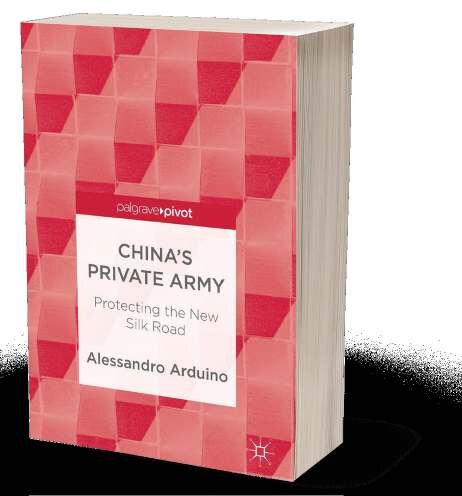
As China’s Belt and Road Initiative (BRI) continues to stretch into regions marked by political instability, concerns about the safety of its investments, personnel, and infrastructure are becoming more pressing. In his book, China’s Private Army: Protecting the New Silk Road , Alessandro Arduino delves into a less-discussed aspect of the BRI: the increasing involvement of Chinese private security companies (PSCs) in protecting these overseas ventures. Instead of focusing on high-level state diplomacy or broad economic impacts, the book explores how outsourcing security has become a practical response to the risks posed by China’s expanding global footprint. Drawing on real-world incidents, such as attacks on Chinese workers in Pakistan and Mali, riots targeting Chinese projects in Kyrgyzstan, and persistent instability in countries such as South Sudan, Libya, and Afghanistan, the book demonstrates that security challenges are not abstract or hypothetical but constitute daily operational threats confronting Chinese enterprises abroad.
Arduino argues that Chinese PSCs represent a unique and developing security model, influenced by China’s political system, legal constraints, and strategic culture. Unlike Western PSCs, which emerged in liberalized security markets and conflict zones such as Iraq and Afghanistan, these Chinese firms operate under strict government supervision. They are closely aligned with Beijing’s foreign policy priorities. Consequently, they act less like independent businesses and more like extensions of the state. This approach, as detailed in the book, reflects China’s preference for protecting overseas interests without resorting to direct military deployment, thereby avoiding diplomatic escalation and maintaining its stated commitment to non-interference. At the same time, Arduino shows that this tight state oversight constrains PSCs’ operational autonomy, particularly in high-risk environments.
The book offers a clear and insightful indication of the legal, institutional, and operational contexts in which Chinese private security companies operate. The author examines their evolution from local security providers to key players on the international stage, mainly within BRI regions spanning Asia, Africa, and the Middle East. He sheds light on international frameworks such as the International Code of Conduct Association (ICoCA) alongside domestic regulations, including China’s 2010 security law, to highlight the persistent lack of clear definitions governing private security activities abroad. This regulatory gray zone, he argues, creates significant challenges for accountability, oversight, and coordination with host states. The analysis is especially important for showing how legal uncertainty intersects with reputational risk as Chinese companies seek to distance themselves from the negative “mercenary” image associated with private military groups.
Methodologically, the book takes a practical approach, using policy documents, interviews, and case studies to explore how Chinese PSCs actually operate. This empirical strategy enables Arduino to move beyond abstract discussions of security and critically assess China’s overseas risk management practices, showing how stateowned enterprises (SOEs) and policymakers have historically prioritized financial and commercial risk while underestimating political, social, and security threats. By tracing these shortcomings through concrete examples, including local resentment, labor disputes, environmental protests, and outbreaks of violence against Chinese personnel and assets, the book demonstrates that the absence of robust corporate social responsibility (CSR) frameworks and effective crisis management mechanisms is a direct contributor to insecurity along BRI corridors. Additionally, Arduino excels at breaking down complex security measures into a clear and understandable narrative. His analysis of specific companies, combined with a contrast to international actors such as Blackwater and Frontier Service Group, adds empirical depth and positions Chinese PSCs within broader global debates on the privatization of security, an issue that theoretical discussions frequently neglect.
Looking ahead, the book examines future developments shaping security along the BRI. It highlights factors such as the growing role of the insurance industry in risk management, opportunities for international collaboration through groups like the AIIB and SCO, and emerging technologies, including cyber threats and drone warfare. These issues are also examined within larger social and geopolitical contexts, including the effects of China’s one-child policy on its demographics and the challenges of managing public opinion in the age of social media.
At the same time, the book’s focus on descriptive institutional mapping limits its broader theoretical contribution. Although Arduino effectively shows how PSCs differ from their Western counterparts, the analysis does not delve deeply into frameworks like security governance or theories of privatization. Furthermore, the absence of a systematic comparison limits the book’s engagement with broader global debates on security privatization. While it acknowledges the political risks of deploying PSCs, there is limited discussion of how such practices might affect the sovereignty of host states or alter long-term local security dynamics.
In addition, although Arduino offers a thorough diagnosis of the problems facing Chinese overseas security provision, he provides fewer concrete policy recommendations for how China and its SOEs can align their economic ambitions with their security needs. Similarly, although the conclusion raises important warnings against a “race to the bottom” in security contracting, where cost-cutting leads SOEs to hire underqualified PSCs, it provides limited evidence on the overseas performance of Chinese PSCs themselves.
Another limitation concerns the study time frame. Since the book was published during the early stages of the Belt and Road Initiative, it primarily focuses on the initial phase of China’s adjustments to overseas security. It does not cover later developments, such as China’s expanded diplomatic security roles or changes in regulations, which fall outside its temporal scope.
Despite these limitations, China’s Private Army makes a timely and important contribution to understanding the security dimension of the Belt and Road Initiative. By combining regulatory analysis, comparative insight, and regionally diverse case studies, Arduino enriches discussions that often focus only on military strength or geopolitical competition within the BRI framework. This book is especially relevant for researchers of international security, Chinese foreign policy, and the global political economy, as well as for policymakers dealing with risk management along key infrastructure corridors.
Overall, Arduino’s work effectively shows how security provision has become a crucial, though often understated, component of China’s global economic strategy. It highlights China’s evolving approaches to protecting the New Silk Road and raises significant questions about the future governance of security under the Belt and Road Initiative.