Full text
WE DISCUSSED THE SCYTHIAN GOLD AND Bactrian treasure trove—considered a prime example of the West’s plundering of the world’s cultural heritage—with Pavel Zarifullin, director of the Lev Gumilev Center in Moscow. Zarifullin has been researching this topic for many years and does not view it merely as a crime of theft. According to Zarifullin, the Scythians are among the most important roots of Eurasian civilizations, and the West is not only plundering their cultural heritage but also trying to eradicate these roots.
The Common Ancestor of the Peoples of Eurasia: The Scythians As an example of the looting of cultural heritage, why are you researching Bactrian and Scythian gold? What is the significance of these treasures?
Pavel Zarifullin: Firstly, I wouldn’t distinguish between Bactrian gold and Scythian gold, because they are, after all, one civilization. The Scythian gold animal style emerged around 1000 BC, three thousand years ago. And it developed within the cultures of the Scythian peoples and related peoples, essentially dialects of the Scythian language.
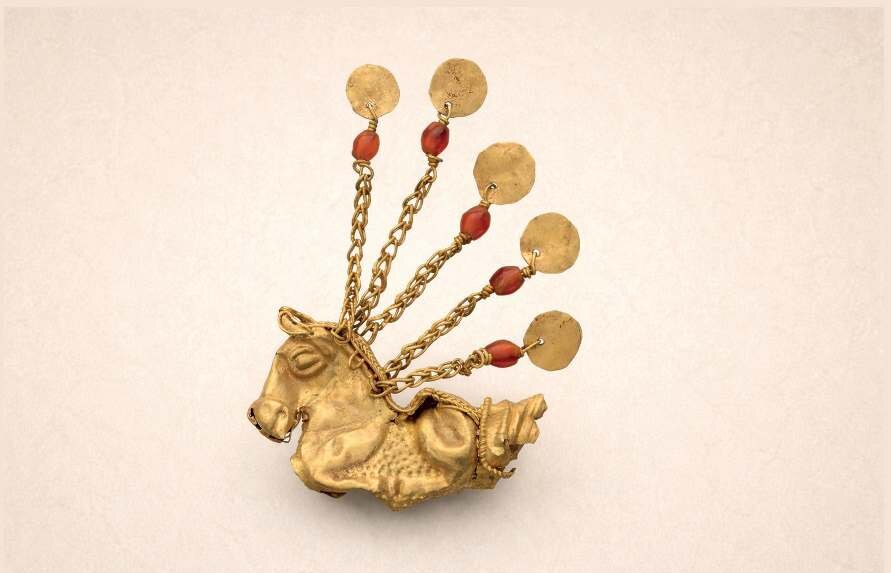
Their culture is incomparable with anything; that is, before them, there were the Aryans who rode chariots. The country of cities in the southern Urals, Arkaim, wonderful metallurgists, remarkable, but that level of Scythian inventions… That level of their exquisite metallurgy, and forging, and worldview, and philosophy… And in general, these captivating golden Scythian items, which are even more elegant than the Egyptian ones, are dynamic and elegant. The Egyptian ones are big and bulky, while the Scythian ones are elegant. They are so alive, practically living pictures of a dynamic universe. So neither before nor after them was there anything like them. Therefore, many people consider themselves descendants of the Scythians, as identifying with them has become very fashionable. Even for the Saxons in the west! Many people across Eurasia believe they descend from the Scythians. The Slavs, the Ugra-fins, the Turks, the Mongols, the Persians, the Iranians, the Pomirs, and even the Indian Kshatri... They all believe they descend from the Scythians. So, they are a truly unique people. I have been studying them with great interest for decades. It’s a whole universe, and once you get into it, you can’t leave it.
The History of the Stealing of the Bactrian Treasure Can you tell us more about the Bactrian Treasure and the process of its discovery?
Pavel Zarifullin: The “Bactrian Gold” is a collection of gold artifacts discovered in 1978 during excavations of Kushan royal tombs dating back to the 1st century BC in the Tillya Tepe region of northern Afghanistan, which means “Golden Hill”. The excavations were carried out by a joint Soviet-Afghan archaeological expedition led by Viktor Ivanovich Sarianidi, a legend of Soviet and Russian archaeology. On ancient maps, what is now northern Afghanistan and southern Tajikistan was called Bactria. Hence, the treasure was named the “Bactrian Treasure”. Approximately three thousand gold objects were discovered in each of the seven tombs. In total, around 20,000 unique gold objects were found: gold jewelry, “animal-style” gold weapons, and many more…
These were the astonishing treasures of the Kushan Empire kings at the beginning of the 1st millennium BC. Descended from the nomadic Scythians, the Kushan kings established a vast state comparable in size to ancient Rome and China. Hellenistic deities, Zoroastrianism, and Buddhism coexisted harmoniously within this state. The Kushans also favored the Scythian “animal style” in their artifacts, and Soviet archaeologists have unearthed magnificent jewelry from the Kushan rulers.
The discovered gold pieces were placed in the Kabul National Museum. At that time, there was a fervent friendship between the USSR and Afghanistan. Babrak Karmal, the then leader of Afghanistan, whom Brezhnev called his best friend, regularly visited Moscow. Because of this warm friendship, the collection was logically donated to Afghanistan instead. Thus, the collection remained peacefully in the museum throughout the entire period of the limited Soviet presence in Afghanistan.
In 1989, following the withdrawal of the 40th Army from the country and amid the crisis, under the orders of then-President of the Democratic Republic of Afghanistan, Mohammed Najibullah, the gold items were moved to the vault of the Central Bank of Afghanistan. This was no ordinary safe; it was a massive, armored safe with advanced security features.
What happened next was a true detective story. After Najibullah’s overthrow in 1992, the keys to the vault were handed over to five trusted Afghan gentlemen from prominent families, including Omar Khan Masoudi, director of the National Museum. The names of the others are unknown. To open the safe, all five keys had to be inserted into the lock at the same time, just like in the movie “The Fifth Element”. The guards agreed that if one of them died, their key would pass to that person’s eldest child. After seizing Kabul in 1996, the Taliban tried every means to obtain information about the treasury’s custodians from bank employees, but despite numerous threats, they were unsuccessful.
American intelligence agents were much luckier; after the Americans arrived in Kabul in October 2001, they quickly discovered the treasure’s whereabouts. In 2003, the location of the Bactrian treasure was officially revealed. A year later, the Americans finally found the keepers of the keys and gained access to the unique Afghan antiquities. Even the great Russian archaeologist Viktor Sarianidi, who made the discovery, was invited to open the safe and verify the artifacts’ authenticity. Over the next two years, the Bactrian Treasure was carefully examined and inventoried.
By the mid-2000s, Afghanistan was almost completely cleared of the Taliban, but the gold collection was allegedly sent abroad for museum display. From December 2006 to April 2007, they were exhibited in Paris under the title “Afghanistan, Rediscovered Treasures.” These unique artifacts subsequently traveled to museums in various European capitals, as well as in Canada and Australia, but, for unknown reasons, they miraculously arrived in the United States rather than back in liberated Afghanistan. Their current location and ultimate fate are only approximately known.
Most likely, they are located in the same place as the 22 tons of gold from the Central Bank of Afghanistan that is “safely stored” at the Federal Reserve Bank of New York. These gold bars were used as collateral for Kabul’s debt obligations. The US has no plans to hand them over to anyone at this time.
The Bactrian Treasure is estimated to be worth billions of dollars, but it is absolutely priceless. I want to point out that this is royal “ritual” gold with the power to improve and influence people’s destinies.
How were the Scythian Gold Artifacts Stolen? How were the Scythian gold artifacts stolen?
Pavel Zarifullin: Another element that adds mystery and illuminates our story is a similar incident that occurred in 2014, when, under the initiative of then-Ukrainian Prime Minister Arseniy Yatsenyuk, Scythian gold from Kyiv museums was taken to the United States under the pretext of a museum exhibition and subsequently disappeared there.
In February 2014, a collection of Scythian gold was taken from Crimea to Amsterdam, Netherlands, where it was effectively stolen. On March 7, 2014, news spread worldwide that Arseniy Yatsenyuk smuggled gold from Kyiv museums to the United States, secured by American loans. We investigated for a long time who was behind it, what kind of organization was involved, and conducted a special investigation together with Komsomolskaya Pravda. Junsei Terasawa, an agent of the American intelligence service and the Elks Club, worked in Chechnya and Tajikistan during the civil war. He was also involved in Maidan in 2014. There, he officially worked for the Geneva Peace Institute through Viktor Yushchenko’s wife, Kateryna Yushchenko. He met Turchynov and Arseniy Yatsenyuk, who led the Maidan protests and seized control of Ukraine in 2014. With their help, in 2014, he smuggled a large amount of gold out of Kyiv to the United States.
The American organization behind all this is: ‘The Bull Moose Club’. So, what is this “Bull Moose Club,” where did it come from, and what is its purpose? In the modern world, the existence of various Masonic and Paramasonic clubs is no secret. Some adhere to rituals dating back to the Middle Ages; members wear special costumes and perform mysterious ceremonies for purposes known only to themselves. Others consist of clubs of the greats, the “masters” of this world; for example, the Bilderberg Group, to which the Rockefellers and all their colleagues and friends belong. The “geniuses” gather in the Bilderberg Group to plan ways to “save humanity,” which means enslaving and exploiting humanity for their own purposes. For decades, the club’s leaders have been acquiring the spiritual and material heritage of the Scythians, Bactrians, and other Eurasian peoples from antique markets around the world.
The Elks Club, like the Bull Moose Club, has a long history in the United States. Scythian artifacts were brought to the United States and continue to be brought to this day: gold, akinakes, mirrors, harnesses, royal crowns, pectorals, and other items of everyday Scythian life. The Elks Club has been involved in this for nearly a hundred years.
The club’s members included some ironic figures from the world of culture. One of them was Bruce Humberstone, the famous director of “Sun Valley Serenade.” If you recall, the main character wears a deer-patterned sweater. Following the film’s release and popularity, sweaters featuring deer and a North Star motif became a global fashion trend and have remained so ever since.
We must Understand the True Treasure We Possess, which is Who We are Finally, what steps should governments take regarding these two treasures?
Pavel Zarifullin: What steps are being taken to counter the Americans and Anglo-Saxons stealing gold from the Scythians, Sarmatians, Kushans, and Bactrians—yes, stealing it and storing it in their own coffers, and the Europeans importing it into their museums, something they’ve been doing for hundreds of years? They might say, “Well, we won’t allow it; we’ll force our government to monitor this gold.”
These have ritualistic significance for them, and they will export them through black-market dealers and some international fraudsters; they will actively participate in this business.
Here, I would appeal to our governments—to the governments of Russia, Kazakhstan, Afghanistan, and Türkiye. But at this point, we ourselves must understand what treasures we possess.
Take Egypt, for example: With the gold of the pharaohs, they essentially created a new nation, even though the pharaohs had no connection whatsoever to the Arabs or the Philaeans of Egypt. They created a gigantic museum, glorifying that civilization to infinity, for the universe to see. The whole world goes to the museums in Cairo and takes selfies there.
We have nothing similar in Eurasia. Although indeed, central Eurasia is the birthplace of modern civilization in general, both in terms of the birth of philosophy and world religions, which descended from the Scythian prophets, and in terms of the birth of technology in general, the wheel, the domestication of the horse, and the birth of war chariots.
Unfortunately, the leadership of Eurasian countries, especially Russia—since I live in Russia and worry about Russia—remembers this very poorly.
If we remember that our movement truly has a slogan: “new Scythians!”, the Scythian gold within each of us—then I think it will be much easier to defend this gold while we understand that it should heal us, heal our peoples, strengthen our peoples, the peoples of Russia, the Slavs, the Turks, the Ukrainians, the Caucasians, all those peoples who believe they descend from the Scythians. We must remember who we are, remember, as Alexander Blok, our great Russian poet, said, “Yes, Scythian and we,” that we all descend from this unique civilization. When we remember this, this gold will not disappear from us, and we will cling to it so tightly and cherish it so much that no one will steal it from us.
It will work not for Masonic clubs, not for their rituals, not for black magic, but for the brotherhood of the peoples of Eurasia. Therefore, we must first and foremost turn to our government, to ourselves, to remember who we are, that we are all Scythians. When we remember this, the gold will return to us.